
Visa Guide · 2026
How to Avoid Study Abroad Visa Rejection: 8 Proven Tips for 2026
Most refusals come from weak files, not weak students. Here is how to avoid study abroad visa rejection, with the rule changes that matter this year.

If you want to know how to avoid study abroad visa rejection, start with one honest fact: a visa officer decides in minutes, using only what is on paper. A bank statement nobody can explain, an SOP that sounds like a template, or a gap left blank can sink a good student. The good news is that every one of these is fixable before you apply.
Quick answer
- Funds: show where the money comes from.
- Course: make sure it fits your studies and work.
- Answers: write them yourself, in simple honest words.
- Documents: names, dates and numbers must match everywhere.
No one can guarantee a visa. Good preparation only lowers your risk.
Why study abroad visas get rejected
Officers look for one thing: is this person really coming to study? Anything that creates doubt becomes a reason to refuse.
| What goes wrong | What to do instead |
|---|---|
| Sudden or unexplained funds | Show savings history, loan letters or sponsor proof. |
| Copied SOP or vague answers | Mention your real course, subjects and career plan. |
| Course does not match your past | Explain the link between your degree, work and goal. |
| Unexplained study or work gaps | Add a short truthful note with proof. |
| Mismatched documents | Check every spelling, date and number twice. |
| Past refusal not declared | Always declare it. |
Visa rule updates for 2026 you should know
- Australia: From 1 July 2026, the Student visa (subclass 500) fee is AUD 2,500 for most applicants. The Genuine Student requirement now replaces the old GTE test, and from 2 October 2026 most new applicants cannot add family members. Check the Home Affairs student visa page before you pay anything, and read our genuine student guide.
- UK: Your CAS, English proof and living-cost funds must all line up. Funds usually need to sit in your account for a fixed period, so confirm the figures on GOV.UK.
- Germany: A blocked account is needed to prove living costs. Confirm the current amount with Study in Germany and TU Munich.
- Ireland and New Zealand: Rules differ by course level, so read Education in Ireland and Immigration New Zealand.
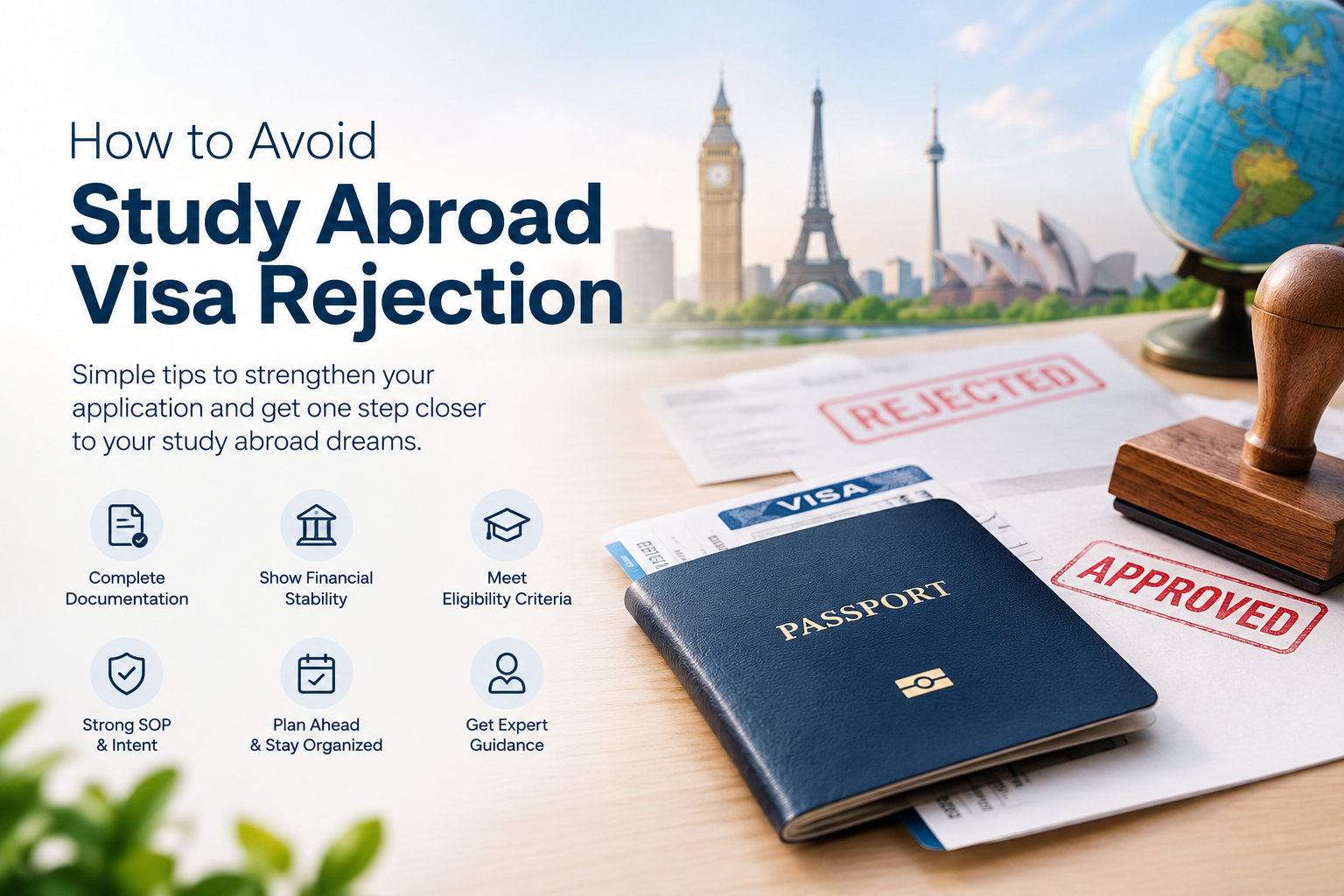
8 proven tips on how to avoid study abroad visa rejection
- Pick a course that makes sense. Your marks, work history and goal should tell one clear story.
- Prepare funds early. Money moved in a week before applying looks suspicious. See our cost calculator to plan a realistic budget.
- Write your own statement. Officers read thousands of similar copies. Your own simple words stand out.
- Explain every gap. A one-line truth with a certificate beats silence.
- Book your English test early. A strong PTE or IELTS score supports both your visa and your scholarship chances.
- Cross-check documents. One wrong date can cause a refusal.
- Never hide anything. False details can lead to a ban of several years.
- Use a registered agent. For Australia, verify them on the OMARA register.
Want your file checked before you apply?
Talk to our counsellors for a free consultation.
What to do if your visa is already refused
Do not reapply in a hurry. Read the refusal letter, find the real reason, and fix it first. A repeat application with the same mistake usually fails again. A registered migration agent can tell you whether to reapply or appeal.
PTE & IELTS classes with a limited-time voucher
A good score strengthens your visa file. Join our classes and claim your voucher.
FAQs: how to avoid study abroad visa rejection
What is the biggest reason for study visa rejection?
Unclear funds and answers that do not sound genuine are the most common causes. Mismatched documents come close behind.
Can I reapply after a refusal?
Usually yes, but only after fixing the reason given in the refusal letter.
Does a high IELTS or PTE score guarantee a visa?
No. It helps, but officers also check funds, course fit and honesty.
Sources: Home Affairs (Australia), GOV.UK, Study in Germany, Education in Ireland, Immigration NZ, University of Melbourne, University of Oxford, Trinity College Dublin, TU Munich.
