Course Guide · 2026
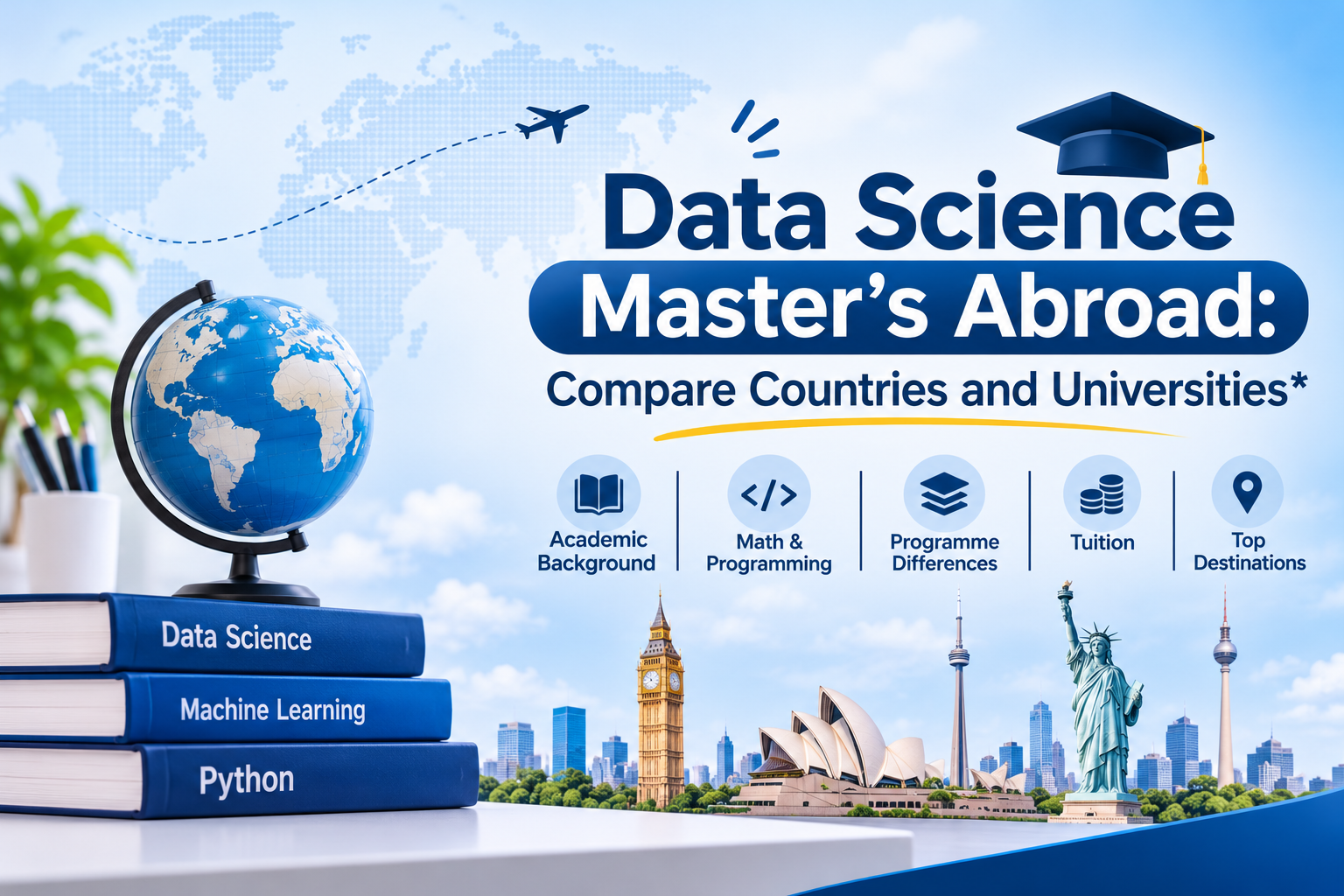
Data Science Masters Abroad: Compare Countries and Universities
Thinking about a data science masters abroad? Here is a clear, honest comparison of six countries: who can apply, how much maths and coding you need, how programmes differ, and what it costs.
Quick answer
Which country is best for a data science masters abroad? There is no single winner. It depends on your degree, budget and career plan:
- UK: one-year degree, but the post-study visa shortens to 18 months from 1 January 2027.
- Canada and Germany: strong value, with a clear route to work after study.
- USA: the biggest job market, but visa and OPT rules are still changing.
- Australia and Ireland: a good balance, if your funds are ready.
You have a B.Tech, BSc or BCA degree, a few Python projects, and a lot of Reels telling you that data science is the future. Fair enough. But a data science masters abroad is a big investment, so the right question is not "which country is famous?" It is "which course fits my background, and can I afford it safely?"
This guide answers that in plain words. We cover entry requirements, maths and programming levels, the real differences between programmes, tuition, and what happens after you graduate.
In this guide
What is a data science masters, and who is it for?
A data science masters is a postgraduate degree that teaches you to collect, clean and analyse data, build machine learning models, and explain the results to people who make decisions. Most courses combine statistics, programming and a final project or dissertation.
It suits you if you enjoy numbers, like solving puzzles with code, and want roles such as data analyst, machine learning engineer or data scientist. It is not ideal if you only want a quick way to move abroad. Employers hire for skills, not for a degree name.
Academic background you need for a data science masters abroad
Most universities want a bachelor's degree with a quantitative base. The closer your degree is to computing or maths, the easier the admission.
| Your background | How strong is the fit? | What to do |
|---|---|---|
| B.Tech/BE in CS, IT, AI, data science; BSc in maths or statistics | Strongest | Apply to MSc/MS Data Science, AI or Data Engineering. |
| Other engineering, physics, economics, BCA | Good, with proof of skills | Show maths modules, Python projects and certificates. |
| Commerce, humanities, life sciences | Possible, but you need a bridge | Choose a conversion or applied programme, or finish a bridging course first. |
Marks matter too. Many universities look for a strong second-class or equivalent result, and some ask for GRE, an aptitude test or a portfolio. Always read the entry page of your chosen course.
Here is a useful example. The University of Edinburgh's Applied Data Science (Online) MSc says it does not require maths or programming beyond school level, so it is designed for career changers. Its on-campus MSc Data Science is more technical and expects programming experience. Same city, same university, very different entry level.
Maths and programming expectations
Here is the honest checklist. You do not need to be perfect, but you should be comfortable with the basics before you apply.
- Linear algebra: vectors, matrices, eigenvalues
- Calculus: derivatives and gradients (used in model training)
- Probability: distributions, Bayes' rule, expectation
- Statistics: hypothesis tests, regression, confidence intervals
- Python or R: loops, functions, pandas, NumPy
- SQL: joins, grouping and filtering data
- Data structures: lists, dictionaries, basic algorithms
- Machine learning basics: train-test split, overfitting
Programmes at technical universities, such as TUM's Data Engineering and Analytics master's, are built for students who already hold an informatics degree. Business-focused analytics courses ask for less maths and more case-study work.
Programme differences: not all data science masters are equal
The course title can mislead you. Two degrees with "data science" in the name may teach very different things, so compare the module list, not just the title.
| Programme type | Main focus | Best for | Example to explore |
|---|---|---|---|
| Data Science (computer science-led) | Machine learning, programming, data systems | CS and IT graduates | Edinburgh MSc Data Science |
| Statistics with Data Science | Statistical theory plus applied modelling | Maths and statistics graduates | Edinburgh MSc Statistics with Data Science |
| Data Engineering and Analytics | Large-scale data, databases, pipelines | Strong coders who like building systems | TUM Data Engineering and Analytics |
| Professional or short master's | Hands-on skills in about 10 months | Students who want a fast, practical route | UBC Master of Data Science |
| Applied or business analytics | Analytics for business decisions | Career changers and managers | Check Melbourne and UNSW course lists |
Programme names and structures change by intake. Confirm modules, duration and fees on the official course page.
Also check these four things before you shortlist: is there a thesis or a capstone project, is there an internship or co-op option, is the degree accredited or STEM-designated (important in the USA), and how many modules are optional.
Data science masters abroad: compare countries, tuition and stay-back
The table shows typical ranges so you can compare quickly. Fees vary by university and course, so treat them as a starting point, then confirm on the official page.
| Country | Typical length | Indicative tuition | After study | Watch out for |
|---|---|---|---|---|
| UK | 1 year | About £25,000–£45,000 for the course | Graduate visa: 2 years if you apply by 31 Dec 2026; 18 months from 1 Jan 2027 | Shorter stay, high living costs in London |
| USA | 1.5–2 years | About US$30,000–$60,000 per year | OPT, plus a STEM extension for eligible degrees | Rules and fees are changing; confirm STEM status |
| Canada | 10 months–2 years | About CAD 25,000–60,000 per year | PGWP of up to 3 years for most master's graduates | Language test for PGWP, high rent in big cities |
| Germany | 2 years | Free at most public universities; €1,500 per semester in Baden-Württemberg; €4,000–€6,000 per semester at TUM | Job-seeker residence permit after graduation | €11,904 blocked account, early deadlines, APS for Indian applicants |
| Australia | 1.5–2 years | About AUD 30,000–50,000 per year | Temporary Graduate visa (subclass 485) | AUD 2,500 visa fee, AUD 29,710 living-cost proof |
| Ireland | 1 year | About €20,000–€35,000 for the course | Stamp 1G stay-back, confirm the length | Fewer seats, limited intakes |
Tuition ranges are rounded estimates for planning, not offers. Living costs are extra. Use our cost calculator guide to build your own budget.
University snapshots for your data science masters abroad
United Kingdom: A one-year master's saves a year of fees and living costs. Explore Edinburgh, UCL and Imperial College London. The catch: the Graduate visa is shorter, so you must land a good job faster. The rules are on GOV.UK.
United States: The USA offers the widest choice of programmes and employers, with universities such as Carnegie Mellon. Ask each university whether your exact degree is on the STEM list, then read the latest student rules on Study in the States and USCIS.
Canada: Master's programmes at public institutions are exempt from the study permit cap from 1 January 2026, and degree graduates do not face the field-of-study list for the PGWP. See IRCC, plus University of Toronto and UBC.
Germany: Great value if you are ready early. Most public universities charge no tuition, but TUM now charges non-EU students for many master's courses. Check TUM's tuition page, Study in Germany and the German Embassy in India for visa steps.
Australia: Strong industry links and a friendly study environment. Look at Melbourne, UNSW and the official Study Australia site.
Ireland: Europe's English-speaking tech hub, with data-focused masters at Trinity College Dublin and University College Dublin. Read the Irish Immigration Service pages for stay-back rules.
What changed in 2026 for data science masters abroad
- UK: The Graduate visa is 18 months for applications made on or after 1 January 2027, and two years if you apply earlier. PhD graduates keep three years. Source: GOV.UK.
- USA: DHS has proposed new OPT-related fees, and public comments closed on 9 November 2026. A separate rule on fixed admission periods is also under legal challenge. Neither should be treated as settled, so check Study in the States before you pay any deposit.
- Canada: Master's and PhD students at public institutions are outside the study permit cap since 1 January 2026, and the PGWP field-of-study list was frozen for 2026. Source: IRCC.
- Australia: The student visa fee is AUD 2,500 from 1 July 2026, and most temporary visa holders must now apply from outside Australia from 2 October 2026. See Home Affairs and our Australia visa cost guide.
- Germany: TUM charges non-EU students for many master's courses, while most other public universities remain free. Source: TUM.
Not sure which country fits your degree?
Call us for a free consultation and a clear shortlist.
How to shortlist your data science masters abroad in 5 steps
- Match your degree to the programme type. Use the table above to see where you fit.
- Fill your skill gaps early. Practise Python, SQL, statistics and linear algebra for a few months.
- Build a total budget. Add tuition, living costs, visa, health cover and loan interest.
- Check the stay-back rules. Confirm them on the official government site for your country.
- Apply early. Start 8 to 12 months before your intake, since German and US deadlines can be early. Our guide on avoiding visa rejection will help.
Wondering about the money side? Read our honest study abroad ROI guide and explore international scholarships to reduce your cost. Many students also plan part-time work, though it rarely covers every expense.
English tests: the score that opens doors
Most universities ask for IELTS or PTE, and postgraduate courses often need about 6.5 overall, with higher scores for some programmes. A better score can also support scholarship applications. Always check the minimum band on the course page.
PTE & IELTS classes. Limited voucher.
A strong English score can improve your offers and your scholarship chances.
FAQs: data science masters abroad
Which country is best for a data science masters abroad?
It depends on your degree, budget and goals. The UK is fast, Canada and Germany offer strong value, the USA has the biggest job market, and Australia and Ireland sit in between. Compare total cost and stay-back rules, not just rankings.
Can I do a data science masters abroad without a computer science degree?
Yes, in many cases. Choose an applied or conversion programme, or build your Python, SQL and statistics skills first. Some courses, such as Edinburgh's online applied programme, do not require maths or programming beyond school level.
How much maths and coding do I need?
You need linear algebra, calculus, probability and statistics, plus Python or R and SQL. Technical programmes expect more, while applied programmes expect less.
Is a data science masters in Germany really free?
At most public universities, yes, apart from a small semester fee. But Baden-Württemberg charges non-EU students €1,500 per semester, and TUM charges €4,000 or €6,000 per semester for most master's courses. You also need a blocked account for your visa.
Which English test should I take, PTE or IELTS?
Both are widely accepted. Check your university's accepted tests, then pick the format that suits you. Our team can guide you with classes and a voucher.
Sources: GOV.UK, Study in the States (DHS), USCIS, IRCC Canada, Australian Home Affairs, Study Australia, Irish Immigration Service, Study in Germany, German Embassy India, TUM, Edinburgh, UBC, Melbourne, UNSW.
Start your data science masters abroad plan
Get a clear, honest shortlist before you apply.
